 |
WORLD LARGEST DISH (MIDDLE EAST)
Some people believe it to be just a myth, but the Guinness Book of Records has the "stuffed whole camel" listed as the largest single food item on any menu, and there are even a few photos of Bedouins feasting on it doing the rounds on the internet.
The official name of this traditional Bedouin dish is unknown, but most people refer to it as a “camel Turducken”. According to most sources it’s sometimes prepared at wedding feasts and special parties in Arab countries like Saudi Arabia. Basically, they get a full-grown camel, take out the insides and stuff it with a few sheep or lambs which are in turn stuffed with about 20 chickens and full of fishes. This calorie atomic bomb has to be boiled then cooked over a pit of burning charcoal until the camel meat is brown and crispy.
I can’t imagine what the pot that can hold a whole camel looks like, but apparently the entire cooking process takes about 24 hours. However, the time period might differ and can take up to more than 24 hours. It needs to be slowly cooked as this meal consist of many meats so that all the meats can be tender. The camel is then served on a silver platter and the wedding guests attack it with knives or their bare hands, leaving only the clean bones.

According to myth-busting website, Snopes, a recipe for stuffed camel actually appears in a cook book called International Cuisine, where it’s listed as a Saudi-Arabian dish. It has all the necessary ingredients and cooking instructions, if you’re looking for a dish that serves between 80 and 100 people. The site also references the introduction of Richard Sterling’s book, The Fearless Diner, where he tells of his meeting with Sven Krause, executive chef at a high-class Bangkok restaurant, who actually cooked a camel Turducken for a sheik’s wedding banquet, while working in Saudi Arabia. He described the process in detail, down to how the wedding guests descended upon the meaty treat and ate the whole thing.
 
http://www.odditycentral.com/foods/the-worlds-largest-dish-whole-camel-stuffed-with-sheep-stuffed-with-chicken-stuffed-with-fish.html
SUMMARY
One of the most popular variations of this dish is in the cookbook ‘International Cuisine’, 1983. This particular version of the recipe says you first skin, trim and clean a medium-sized camel, lamb, and chickens and boil them until tender. Precook the stuffing: peel hard boiled eggs, cook fluffy rice and mix it with fried nuts. This stuffing goes into chickens which together with more rice go into a lamb. Finally, the whole camel should be stuffed with the stuffed lamb and even more rice, wrapped in palm leaves and broiled until brown over large charcoal pit 3 feet in depth and served with rice. I'm still figuring how would they fit a whole camel into a pot, perhaps all the big pots were invented by the Arabs in conjunction to this dish. It is to be said that this humongous dish can feed as many as 80 people. However, if this dish were to served for Malaysians it could feed as many as 200 people approximately as we Asians are not as heavy eater as the Arabs.
BONUS FACT
http://www.todayifoundout.com/index.php/2011/05/the-worlds-largest-item-on-a-menu-is-stuffed-camel/
|
Friday, 26 June 2015

 |
CASU MARZU (MAGGOT CHEESE) HOW ITS MADE
The cheese is steeped in history and has been made by Sardinians for hundreds of years. Sans maggots, it's similar to pecorino: an Italian cheese made from sheep's milk. The main difference is that after it's made, a hole is cut in the top and the cheese is placed outdoors where cheese flies (Piophila casei) can find it and use it as a cheap hotel room for trysts and baby making.
Why would you want flies to lay eggs in your cheese? Well, the eggs hatch to become maggots and these larval flies eat the cheese, leaving behind excretions of pre-digested fats, proteins, and sugars. Basically, the larvae are fermenting the cheese to an extreme degree. While cheeses that are aged in ways we're more familiar and comfortable with tend to lose moisture while developing flavor, casu marzu becomes very soft as it develops flavor.
HAZARDS OF DINING
Aside from the sheer cringe factor of eating live worms (Sardinians believe that the cheese is unsafe to eat when the maggots have died) eating casu marzu can be logistically challenging. The maggots in the cheese get upset when the cheese is disturbed and can actually jump around. And when I write jump, I don't mean inch around a little, I mean launch themselves for distances of up to 6 inches! To prevent their meal from literally hopping off the plate, diners will hold a hand above the cheese spread bread slice as they raise it to their mouth. Personally, if I were to try it I'd go with some stylish onion goggles.
NOT ALONE
While casu marzu is the most well known "maggot cheese" it's not the only one. Other cheese known for containing live insect larvae include:
Can I Try It?
You can't buy casu marzu in the U.S. (the legality of the cheese is a matter of contention in the EU, which means it can't be exported for purchase here). It used to be that if you were dying to try a cheese created by living critters, you could get a hunk of Mimolette, but as of October 2013 the FDA started banning the import of Mimolette from France due to the tiny mites that live on its rind. Until the FDA relaxes its standard of 6 mites per square inch, you'll just have to enjoy less lively cheeses.
http://www.huffingtonpost.com/culture-magazine/casu-marzu-aka-maggot-che_b_5086446.html
|
 |
| BALUT - PHILIPPINES
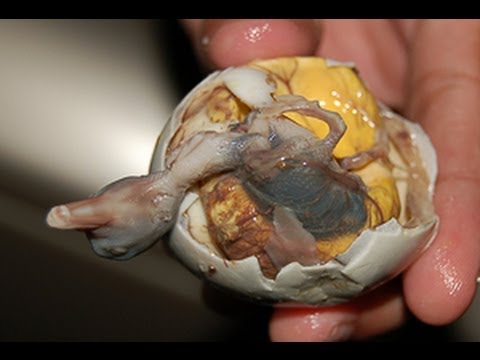
If you're of Filipino or other Asian descent, balut eggs might not sound at all exotic. But if you didn't grow up with Asian foods, eating balut might be out of your food comfort zone. Balut eggs, considered a delicacy, are fertilized eggs that contain partially developed duck embryos. Although duck eggs are commonly used, you can also use chicken eggs. Mallard eggs are used most commonly, but Muscovy duck eggs are thought to make the best balut.
EGG DEVELOPMENT
Most eggs you buy in your local grocery are unfertilized eggs, produced by hens who don't have access to roosters. Fertilized eggs rarely make it to market; egg sellers check them for the presence of an embryo by candling, a technique that illuminates the shell and makes it transparent. Fertilized duck eggs normally incubate for 28 days, while fertilized chicken eggs incubate for just 21 days. Balut eggs have incubated for a total of 18 days for duck eggs and 13 to 14 days for chicken eggs, according to the University of Kentucky Cooperative Extension. At this stage, the bones are soft enough to eat and the feathers haven't yet developed
COOKING
Unlike regular eggs, balut eggs fall under the category of an ethnic food. As such, they do not undergo the same inspections and grading that regular eggs undergo, according to the United States Department of Agriculture. You can purchased balut uncooked or already cooked. If they are not already cooked, hard-boil the eggs for 20 to 30 minutes before eating them. Hard cooking will kill any bacteria that might grow in the eggs during the incubation period.
EATING
After hard-boiling, eat the balut directly from the shell. Eat balut while it is still warm. Don't eat the shell itself. Look at the egg to see which end is larger, peel the top part of the shell, break through the membranes and sip the amniotic fluid liquid from the egg. The egg contains the duckling embryo, the egg yolk and the albumin. The yolk and embryo are completely edible. Many consider the albumin too tough to eat and discard it. Filipinos traditionally season the egg with salt, vinegar or soy sauce as they eat it. Discard the shell when you finish the inside ingredients.
BENEFITS
Although balut might not sound appealing if you haven't grown up with it, it does make a nutritious snack, high in protein and calcium. A serving of balut contain 188 calories, including 14 grams each of protein and fat, 2 milligrams of iron and 116 milligrams of calcium.
SUMMARY
Balut eggs can typically be purchased from a street vendor who will often keep them warm in a bucket of sand. Duck eggs that are not properly developed after nine to twelve days are not sold as balut eggs but instead sold as penoy, which look, smell and taste similiar to a regular hard-boiled egg. In filipino cuisin, these are occasionally beaten and fried, similiar to scrambled eggs.
http://healthyeating.sfgate.com/balut-egg-2775.html
|
Subscribe to:
Posts (Atom)